Voting for the Public Schools We Deserve
October 31, 2026

October 31, 2026
November thankfully presents us with cooler weather and an opportunity to have a say in the future. But much like the school year that is well on its way, the groundwork for a successful November was laid months in advance and will continue to require hard work after our votes are cast. And while we don’t know the outcomes of the elections yet, we must do everything in our power to achieve the schools a democratic society deserves. The future of public schools —their funding, our working conditions, and the experience of students— is deeply impacted by our actions. Most critical is securing the fair and comprehensive collective bargaining bill we were promised. But first, let’s look at who and what is on the ballot and review VEAs endorsements and our legislative agenda.
It is all too easy for the same old politicians, to side with big businesses, billionaires, and special interest groups, meanwhile forgetting that their constituents are working people who want to build a life in the Commonwealth. When politicians underfund our schools and then blame us for not reaching ever-moving goal posts, we have elected poorly. We need to have elected officials who respect us and listen to our input. To that end, included below is the list of school board candidates who have earned VEA’s endorsement. In the future, more educators should run for office, so that public school decisions are made for us and by us. Many educators work in schools that are neglected in ways politicians cannot even imagine; the buildings are fire hazards or crumbling, are mold ridden, or too hot. In order to generate the additional funding needed to address these capital projects, a one percent sales and use tax has been added to the ballot in certain cities and counties and could be added to more localities in the future. Also on the ballot are three constitutional amendments, all of which VEA has endorsed a yes vote on for their support of the freedom and democracy that go hand-in hand with the common good of public schools. Whether or not you’ve cast your vote, it’s important to know exactly what is being discussed and how we can ensure we’re working towards the public schools we, and the students, deserve.
Over 159 school board candidates are running in Virginia this year. In particular, Virginia Beach and Chesterfield County are home to highly competitive school board races that will not only shape public education but decide the future of collective bargaining in their locality. Just a few local PAC-recommended candidates include:
VEA is also proud to see longtime VEA member and 36-year educator Freda L. Curtis running for the seat in Petersburg School Board Ward 3. Freda brings a passion for student success and years of experience advocating for quality public education. There are many more seats up next year, and beyond. Rather than voting next year for the people who we believe will best listen and respond to our voice, we need to take power in our own hands and run for these school board seats ourselves. No one knows what public schools, their employees, and students need to succeed like folks who have years of actual public school experience. To support these efforts, NEA has launched a program called Education Votes, which engages members and allies in securing candidacies for office. The See Educators Run training, hosted through Education Votes, arms members with everything one would need to know about mounting a successful campaign, including fundraising and communicating with voters. Running for office can feel intimidating, but if public school employees don’t step up to ensure our agendas are implemented, we will continue to fight with politicians who are less experienced in what it takes to prepare a child to reach their full potential. And who knows, you might be surprised at how impactfully you articulate your ideas when skills are sharpened with NEA backed training and support. Simply running for office sends a message that education decisions need to be made by educators, and we start to pull the needle toward respect for our profession and the insights that come with the experiences of the job.
Each year, the state provides a set dollar amount to localities for school operations like programs and staffing, but much harder to secure are funds for larger ticket items like school facilities construction and repair, which are usually funded through slow-moving grant programs. Many educators have experience with crumbling, outdated buildings that at worst are health hazards, or simply are not a fresh environment for generating new ideas and modern education practices. In 2021 the Virginia Department of Education’s Needs & Conditions study documented a multi-billion-dollar backlog of school facility needs, a number that has only increased in the years that followed. This 1 percent sales tax is a creative way to tackle this expensive and hazardous issue and empowers localities to decide on the state of their public schools. Additionally, this tax will not apply to most regular spending; for example, groceries, essential hygiene products, gas, prescription medications, vehicle purchases, home heating fuel, and labor are all unaffected by the tax. Retail purchases such as clothing, electronics, and restaurant meals would be taxed if a proposal was adopted. Based on national spending data, the cost of this tax to the average family of four would be roughly $13 a month. Although everyone’s dollar is not stretching as far as it used to with high inflation and costly groceries and gas, $13 a month to address neglected school buildings is a good deal. Further, everyone takes part in these taxes, including visitors, commuters, and out-of-locality shoppers, so if you live in an area reliant on tourism or shopping, your schools could see a major facelift. Localities across the Commonwealth have the option to ask voters to approve an additional local sales tax of up to 1 percent to help fund school construction and major renovation projects.
This means adding one cent per dollar to the existing state and local sales tax rate but could add up to hundreds of millions in project funds for the state in the first year. See the box below for the full list of the 47 localities which have the proposal on their ballot or have already implemented the tax. If your locality isn’t posing the question on the ballot this year, reach out to your elected officials to advocate for it’s addition. to see where your locality stands on the issue next year.
Unlike many tax provisions, these changes aren’t forever because there is a sunset clause which ends the additional tax, typically in 20 years, or when any bonds are paid off, whichever comes first. This ensures that this tax goes only to the improvement of school buildings and ends when this long-neglected issue has been addressed. Investment in our school buildings is desperately needed, and if this ballot measure passes in your locality, it will have tangible results in the quality and safety of your workplace.
Virginians for Modern Schools is a statewide coalition of school boards, supervisors, superintendents and other stakeholders who are advocating for adoption of this sales tax. You can learn more about the 1 percent sales tax on their website: www.virginiansformodernschools.org.
This year there are three proposed constitutional Amendments on the ballot, all of which VEA has endorsed. The first addresses freedom to make personal decisions around prenatal care, childbirth, and abortion while also protecting doctors, nurses and patients for these decisions. The second ballot question removes the current constitutional ban on same-sex marriage and affirms that two adults may marry “regardless of sex, gender, or race.” The third proposal asks whether voters would like to restore voting rights to individuals previously incarcerated for felony convictions. This last amendment fine-tunes the language of those prohibited from voting from “mentally incompetent” to “persons who have been found to lack the capacity to understand the act of voting.”
Year after year vouchers are repackaged and sold as the solution to the challenges public schools face. Yet time and time again, research shows that they in fact do not address diverse access to high-quality schools, supports for students with disabilities, or support parental school choice. Vouchers do nothing more than drain the already shallow pool of public schools’ funds and erode a public sector good in favor of privatization. Vouchers also harm rural communities, as only 34 percent of rural families live within 5 miles of a private school, yet they would still carry the tax burden supporting vouchers. Said another way: all of the cost, with none of the benefits. This year, a narrowly passed section in the “Big Beautiful Bill” allows for individual donations to private scholarship organizations to be rewarded with a matched tax credit up to $1,700 (or $3,400 for joint filers). So rather than those tax dollars funding the public schools that educate over 88 percent of Virginia’s K-12 students, they would be diverted to individuals funding privatized, often religious, schools. Where there was once a cap on how much of these public funds could be rerouted, there is no longer a limit on how much could be diverted. Estimates from the NEA put the approximate loss to public schools at $25 billion. Further, because in Virginia, public school funding is based on enrollment, if even just a few students leave, the funding drops while the costs, like staffing and electricity, for the rest of the schools remain the same.
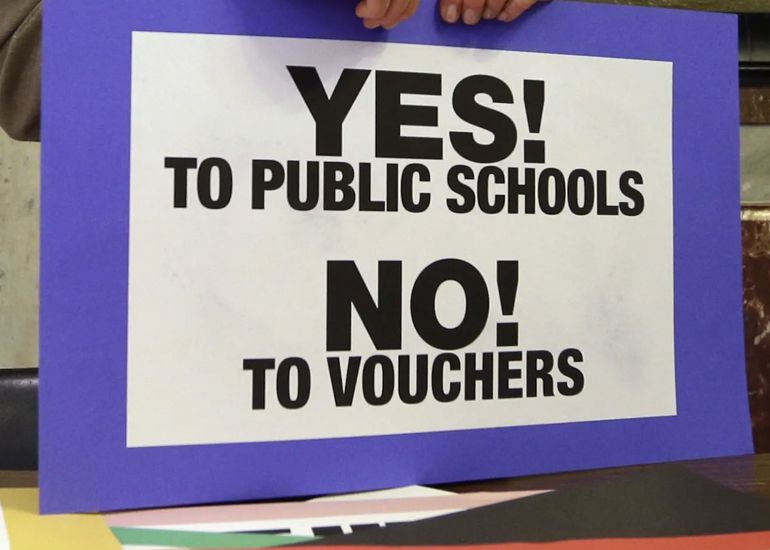
Loss of enrollment can snowball into major impacts to public schools, which could translate into annual losses of $222 million to $956 million. But Governor Abigail Spanberger can opt Virginia out of the program and protect Virginians. Opting out would also align with what Virginia voters have repeatedly shown they want. Since 1970, Virginian voters have rejected every single attempt to create or expand private school vouchers via ballot referendum, however, it is unclear yet if Governor Spanberger wants to align herself with the will of her constituents or if she is pro privatization, backing Betsy DeVos and the Trump administration. VEA members must make sure that their legislators and the governor know their position on this issue. It is not enough protection to assume that the historic public opinion will be heeded, and our loud, collective voice needs to be clear: vouchers have no place in Virginia.
Despite not winning the collective bargaining law we were promised, our last legislative session in 2026 was the most successful we’ve had in years thanks to the hard work and advocacy of VEA members. This year, we need to build on that momentum, and we’ve set some aggressive goals. You can see the wins from 2026, which laid the groundwork for the 2027 legislative session agenda, The 2027 session begins on January 13th and most likely will last for 45 days. During this time, VEA is leading roughly 50 bills which promote and protect public schools and public school employees. We’re also supporting or opposing hundreds more as we simultaneously advance our goals and defend against attacks on our collective bargaining rights, attacks on funding via vouchers, and other freedoms of expression and democracy.
Governor Spanberger’s veto of the collective bargaining legislation that was the culmination of years of collaboration between labor unions, coalition partners, and stakeholders from across the Commonwealth was a major defeat-one that cannot stand. After publicly and privately committing to pass the bill and provide a seat at the table to public sector workers, Spanberger exercised her veto power when the General Assembly did not accept her changes, which gutted the powers of the collective action in the bill. It is critical that VEA push the Governor to honor the promises she made on the campaign trail and fulfill her promises to workers and her constituents. Not only does collective bargaining allow workers a seat at the table, to discuss as equals the work that we have dedicated our lives to, it also improves teacher retention and the learning environment of the students we serve. Where collectively bargained contracts have been implemented at the local level, pay has increased and workers have received better benefits, while also receiving more respect for the work that they do.
VEA, working with the Labor Coalition, has come up with four priorities that must be included in any collective bargaining bill. It is important that we know these priorities and the details of the bill inside and out. As the defenders and promoters of this bill, we cannot allow politicians to mislead us or guide legislation in a direction which does not benefit those impacted. The first priority states that all public sector workers receive the right to collectively bargain their contract in one move, not with staggered start dates. Picking which workers deserve first access to the rights and benefits of a seat at the table is a way to divide us and runs the risk of leaving those waiting for their turn to face unfair working conditions with no end in sight.
The second priority relates to protecting the neutrality of the Public Employee Relations Board (PERB), which is a decision-making agency that settles disputes between two parties. In relation to the collective bargaining bill, PERB would settle disputes between an employer, the labor union, and/or an employee. The PERB establishes regulations such as the procedure that must be followed for union certification, as well what constitutes as unfair labor practices. Ensuring that the collective bargaining bill does not degrade into simple PERB regulations protects workers rights from politicalization and the whims of the Governor, who decides who sits on the PERB. Thirdly, workers need recourse if they are illegally fired for exercising their labor rights. If employers are not made to financially compensate fired workers, there is no penalty for participating in union-busting.
Lastly, some critics argue that the General Assembly is overstepping its powers and disempowering the schools boards’ constitutional responsibility to supervise how schools are run by laying the ground rules for deciding binding arbitration between school boards and unions. This claim is false, as nearly 50 years ago the Virginia Supreme Court ruled that collective bargaining is not part of school boards’ constitutional responsibility. The General Assembly, in fact, wrote the definition for school board authority and power, and if they decide that collective bargaining, alternative dispute resolution, and impartiality ensure a high quality education, then they are within their rights to codify that into law. Without ensuring a neutral third party to settle disputes between parties, the school board would have the final say in all contract negotiations and disagreements, which, especially without the legal ability to strike, would not function as a meeting of equals deciding together what is best for public schools. While all of this can feel in the weeds, educators must master this information, so it cannot be used against us. As teachers become subject matter experts on the lessons they prepare for students, or an ESP knows the best intervention for a child, we as workers must know the best way for us to have a say in our workplace.
There’s much to be upset about, but educators don’t throw temper tantrums, they organize. The Trump Administration is pitting us against each other. Our prices are increasing, folks are struggling financially, and their agenda’s making us sicker, less democratic, and less safe to practice our profession. But we choose solutions over division. This November, educators must elect leaders who represent public school employees, and VEA members must be brave enough to hold them accountable. Calling the Governors office to continue to push for the collective bargaining bill we were promised, and we deserve, will help to keep the pressure up. Thanking our legislators who have been supporters of collective bargaining and urging them to continue to fight will also reinforce the goals that we have as an organization. And, showing up in force on Lobby Day, January 18th, will send the unmistakable message that VEA members are the political authority when it comes to public schools. We were promised a collective bargaining bill that would not only protect and empower us, but would allow us to spend more time doing what we are passionate about: educating children. Precious time is wasted while we are forced to fight in order to secure the right to be included in decisions about us. Continuing the fight can feel deflating, as so much time and effort has already been expended. So many of us are spending our own money in the classrooms, while watching our dollars go shorter distances at home.
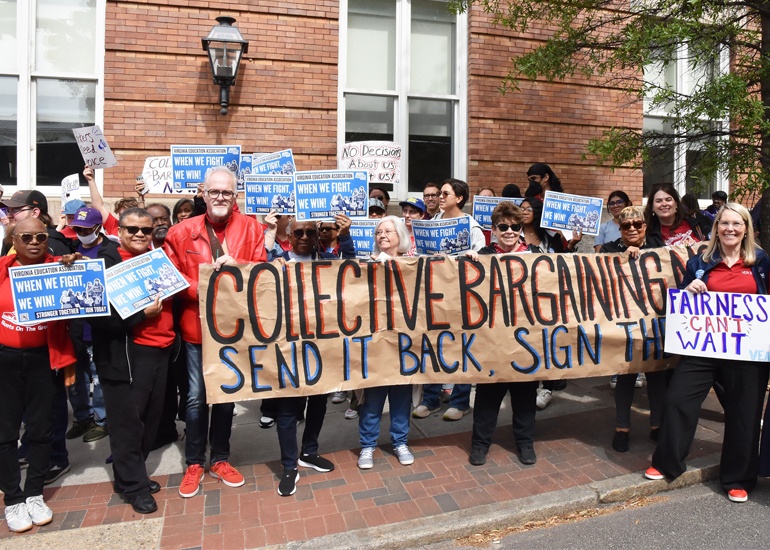
We are often expected to work outside of our contracted hours to meet the enormous tidal wave of responsibilities. We feel the importance of the work that we do, and caring for children can feel like an impossible task to place boundaries around. But we can use this exhaustion, burnout, and anger to build the conditions that will solve those problems. With a strong Collective Bargaining for All Bill, we will enact meaningful changes that ensure we will approach the national average on teacher pay, ensure respect and pay increases for ESPs, improve the safety of our workplaces, and so much more.
Accountability is needed from politicians across the state and on both sides of the aisle. In order for our representatives to give us the respect and funding educators deserve, Lobby Day needs to be a sea of educators so thick, there is no question as to who will put our public schools back on track. Even though educators are overworked and underpaid, exhausted and stretched too thin, this push is how we will make a difference in our circumstances. On the other side of this struggle is a world we all know is possible. A world where school buildings are safe, where time is valued, the profession is respected, and students thrive. It will not come easily, but as educators, we know this better world is worth the effort.
Kate O’Grady is the editor of the Virginia Journal of Education.
El salario medio de los profesores de las escuelas públicas de Virginia en 2023-24 fue de 65.830 dólares. Es decir, 4.260 dólares por debajo de la media nacional de 70.090 dólares.
Más información