
• Instagram
  • Twitter
  • Facebook
  • Find Your Local
  • Member Log in
  • Join
Virginia Education Association
Skip to content
  • Home
  • About
    • Who We Are
    • Our History
    • Leadership
    • Staff Directory
    • Find Your Local Association
    • VEA Careers
  • Membership & Benefits
    • Join VEA
      • Why Join?
      • FAQs
    • Member Center
      • Member Log In
      • Member Center Home
      • Find Your Local Association
      • Awards & Grants
      • Your UniServ Program
      • Member & Leader Resources
      • Organizing Resources
      • Member Savings
      • Legal Services
      • License & Contracts
      • Retirement Planning Center
      • VEA Elections
    • Our Members
      • Teachers
      • ESPs
      • SVEA Aspiring Educators
      • VEA-Retired
  • Take Action
    • Collective Bargaining Legislative Advocacy Hub
    • VEA On the Issues
    • Legislation & Policy
    • VEA Fund
    • Human and Civil Rights
  • News & Events
    • VEA Events Calendar
    • The Latest from VEA
    • Virginia Journal of Education
    • Videos & Photos
    • Social Media Center
    • Press Releases
    • Media Inquiries
  • Contact
  • Find Your Local
  • Member Log in
  • Join

Keep Virginia Out of Trump’s Federal Voucher Program

Keep Virginia Out of Trump’s Federal Voucher Program - VEA Website

Under the Trump Administration, the privatization movement has achieved a major, long-term goal: the first federal voucher program. The Education Freedom Tax Credit program– passed under HR1 (the “Big Beautiful Bill”) with the backing of billionaires– has been hailed by President Trump as, “the largest ever expansion of school choice.” 

This presents the following risks to public schools and our democracy:

The program will divert money from public schools to private schools.
  • This program could accelerate declining enrollment in public schools, which will in turn receive less per pupil funding, but will still need to cover the same fixed costs like buses, heating/AC, building maintenance, etc. 
  • Public schools already suffer from chronic underfunding and with state budgets strained, state governments will face even more challenges to fully fund schools 
  • Virginia public schools could lose almost $1 billion annually in funding, assuming similar uptake rates to Arizona’s program. See this link for more information on individual divisions.
This program is regressive and will deepen existing educational inequities
  • The program is positioned to mostly benefit the 10% of students already attending private schools, who are from relatively high income families on average. 
  • Of public school families expected to utilize this program, a Brookings analysis shows that the wealthiest counties are projected to take advantage of the program. Lower-income and rural areas are expected to miss out on the benefits. 
Vouchers are not effective at improving student outcomes.
  • Where vouchers have been attempted there have been reductions in student achievement, according to every large-scale study. 
The program is extremely expensive.
  • The Treasury estimates the program will cost $26 billion annually by 2030 assuming a 10% take up rate. An estimate by ITEP assumes a roughly 20% uptake rate, which would result in a nearly $51 billion annual loss. Compare this to annual spending on Title I for students facing economic disadvantage ($18 billion) and spending on IDEA for students with disabilities ($15 billion). The federal voucher program could be more than these two programs combined.
  • States will not be able to restrict money to only public schools and public schools will have more burden than private schools to build the infrastructure to accept any funds 
  • The state would have to pay additional administrative costs to administer this program according to the guidance. 
This program will likely generate waste, fraud, and abuse, with little spending oversight.
  • While the Treasury is still producing guidance around eligible expenses, there are previously documented accounts of Arizona’s program leading to spending on hotel stays, sneakers, makeup, and more.
Vouchers were previously implemented to resist desegregation and continue to intensify segregation and deepen civil rights concerns.
  • Vouchers were implemented in Prince Edward County to resist desegregation and allow white students to continue to access schools, while Black students faced school closures 
  • There is evidence that vouchers increase already high levels of school segregation 
  • Furthermore, private schools are not subject to the same civil rights protections and accountability standards as public schools


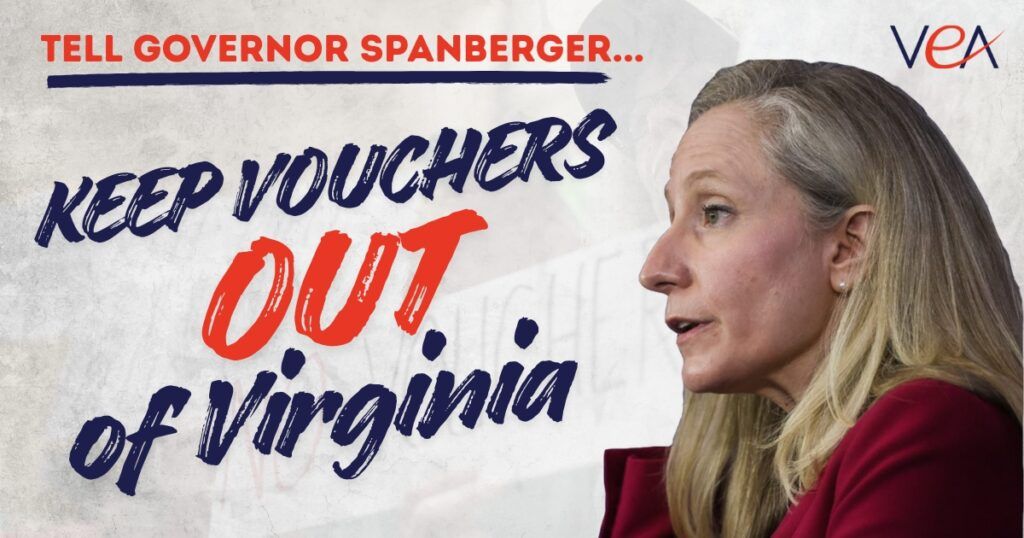
States must choose to participate in the program. Governor Youngkin attempted to opt Virginia in before he left office, but Governor Spanberger has the final word and doesn’t have to finalize Virginia’s participation.

Governor Spanberger has not announced a decision, so we need your help! We need advocates and local school boards to make their position to Governor Spanberger clear: Virginia does not want any part of Trump’s privatization push.

You can help by organizing in your area using the resources below!

 If you believe your school board would likely support a resolution, consider using these resources! Reach out to Emma Clark eclark@freedomva.org for support and to determine if this is the right strategy for your locality.

Tell Gov. Spanberger: No Vouchers in Virginia!

Tell Governor Spanberger to reject Trump’s national voucher program. Share the petition with your members and community.

Sign the Petition Here

Share Information With Your Members and the Community!


6 Reasons to Reject Vouchers


Why States Should Say “No” to the Federal Tax-Credit Voucher Program


How Much Money Your School Division Could Lose


What's at Stake for Virginia's Public Schools


VEA Statement Explaining Treasury Guidance


New Report Details How Trump's Plan to Privatize Public Education Hurts Students


Civil Rights Organizations Urge Governors to Reject the Trump Administration’s Federal Private School Voucher Scheme

Get Your School Board to Pass a Resolution

  • School Board Resolution Template
  • Regional Income Cap Reference

Did You Know?

According to the Economic Policy Institute, teachers in Virginia earn 67 cents on the dollar compared to other (non-teacher) college-educated workers. Virginia’s teacher wage penalty is the worst in the nation.

Learn More

  • Virginia Education Association
    8001 Franklin Farms Drive, Suite 200
    Richmond, VA 23229
    Tel: 804-648-5801 or 800-552-9554
  • Twitter
  • Instagram
  • Facebook
  • Pinterest
  • Vimeo
  • Flickr

© 2026 Virginia Education Association. All Rights Reserved.
  • Privacy Policy
  • Terms of Use
  • Español