Black Educators: A Journey of Advocacy, Loss, and Importance
February 10, 2026

February 10, 2026
By Adjua Lafleur
The journey of Black educators contains growth, loss, and ongoing advocacy. It began with newly freed people and abolitionists organizations establishing schools for Black children after the Civil War, peaking at over 82,000 segregated schools before 1954. However, long before emancipation, many enslaved people risked torture to learn to read and write.
The formerly enslaved who were literate became some of the first teachers for the freed people. Black communities lead their own educational development. They built, furnished, and maintained schools with their own labor and scarce funds. A lot of the schools were small, sometimes only a single room, but they were rooted in pride and purpose. The Freedmen’s Bureau, created by Congress in 1865, played a key role in expanding education for freed people in the South and border states. The Bureau placed teachers in schools, often working with Northern organizations to recruit and pay them. Northern organizations like the American Missionary Society (AMA), an abolitionist group, recruited and paid teachers willing to relocate to the south to work in Black schools. AMA assisted in the founding of over 500 schools and colleges for freed Black people in the South.
The first Black colleges, known as Historically Black Colleges or Universities (HBCUs), made teacher preparation a fundamental goal because of the critical need for educators. Graduates often returned to Black schools, generating a self-supporting system that produced Black educators committed to serving their own communities.
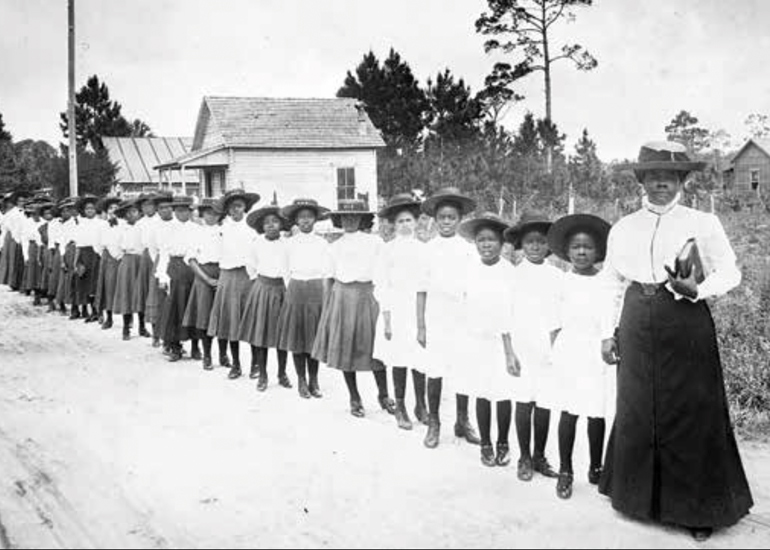
The first Black colleges, known as Historically Black Colleges or Universities (HBCUs), made teacher preparation a fundamental goal because of the critical need for educators. Graduates often returned to Black schools, generating a self-supporting system that produced Black educators committed to serving their own communities.
While the Black community had educators willing to do their part, there were still resources that White schools received that Black schools did not. In 1933, Black Educators and the NAACP began to organize an equalization campaign. From 1933 to 1950, the NAACP and its legal team, led by Charles Hamilton Houston and later Thurgood Marshall, fought to equalize school facilities and teacher pay. The Equalization Lawsuits sought to gain access to resources exclusively limited to White schools and acquire equal funding for Black schools. Their efforts lead to a realization that true equality within segregation was impossible.
The 1954 Supreme Court ruling in Brown v. Board of Education (BOE) declared that state laws establishing separate public schools for Black and White students were unconstitutional. The ruling’s intent was to provide Black students access to quality educational resources equal to their White counterparts. As a result, segregation was made illegal.
After Brown v. BOE, tens of thousands of Black educators and administrators, who played an integral role in the lives of generations of Black students under segregation, were fired or demoted. As white-controlled school boards consolidated power, Black schools were closed or stripped of resources. For many Black schools, the history of their existence disappeared. While Brown v. BOE called for the integration of students, the integration of staff was not guaranteed. White-controlled school boards often demoted Black administrators or refused to hire Black educators to teach in formerly White schools. The legal basis for segregation was dismantled but the professional networks and community influence that Black educators built under Jim Crow was fractured.
The journey of Black educators has been both challenging and transformative. Throughout history, Black educators have not only shaped the future of their students but have also served as symbols of resilience, resistance, and hope. Today, as we face a national teacher shortage and an education system that is under attack and still grapples with disparities, the need for educators who reflect the diversity of the students they serve has never been more urgent. In 2022, approximately 9.4% of teachers were Black compared to the 71.7% of White teachers (National Center for Education Statistics). The work of Black teachers continues to be vital in breaking down barriers, raising expectations, and nurturing the next generation of leaders. The journey of Black educators must continue.

The Unintended Consequences of Brown v. Board of Education – Click here
Resources
https://curiosity.lib.harvard.edu/black-teacher-archive
https://usafacts.org/articles/who-are-the-nations-teachers/
Adjua Lafleur is a VEA Uniserv Director serving members in Fairfax. Previously she was a biology teacher in New Jersey where she was also a local union rep.
According to the Economic Policy Institute, teachers in Virginia earn 67 cents on the dollar compared to other (non-teacher) college-educated workers. Virginia’s teacher wage penalty is the worst in the nation.
Learn More